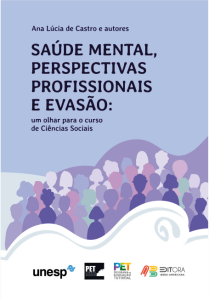
Mental health, professional perspectives, and dropout: a look at the social sciences program
Keywords:
Social sciences, Study and teaching, Research, Higher education, Mental healthSynopsis
The book, organized by Ana Lúcia de Castro, presents the results of the research conducted by the PET Group in Social Sciences at UNESP – Araraquara (2024–2025), which investigated the students’ profiles and the causes of dropout in the program. For every 100 students admitted annually, between 30 and 40 withdraw from the course—a number that exceeded 50 during the pandemic and remained high even after the return to in-person classes in 2023. The research is based on the hypothesis that the acceleration of daily life and the digitalization of social relations have transformed the ways of learning and teaching, thereby widening the gap between university and society. These factors are compounded by the limited job market and the difficulties students face in remaining enrolled. The data were processed statistically and categorized using NVivo software. Subsequently, focus groups were conducted with graduates and former students to deepen the understanding of the motivations and circumstances related to dropout. The process also had an educational component, enabling members of the PET group to develop skills in social research and data analysis.
Downloads
Download data is not yet available.
References
BRASIL. Lei nº 13.709, de 14 de agosto de 2018. Dispõe sobre a proteção de dados pessoais e altera a Lei nº 12.965, de 23 de abril de 2014 (Marco Civil da Internet). Diário Oficial da União, seção 1, Brasília, DF, ano 155, n. 157, p. 59-64, 15 ago. 2018. Disponível em: https://www.planalto.gov.br/ccivil_03/_ato2015-2018/2018/lei/l13709.htm. Acesso em: 23 out. 2024.
CRAVO, G.; MEDINA, F. Reflexões sobre mercado de trabalho para cientistas sociais pressões por mudanças curriculares. Cadernos da Associação Brasileira de Ensino de Ciências Sociais, v. 1, n. 1, p. 92–108, 2017. Disponível em: https://cabecs.com.br/index.php/cabecs/article/view/17. Acesso em: 27 set. 2024.
DOWBOR, L. O capitalismo se desloca: novas arquiteturas sociais. São Paulo: Ed. SESC, 2020.
LIMA, J. C.; BOMENY, H. A formação em sociologia: de volta ao futuro. Rev Sociologia e Antropologia, v. 15, n. 2, 2025. DOI: 10.1590/2238-38752025v1521. Disponível em: https://www.scielo.br/j/sant/a/h54Gt4CwfS6ynxC5B9hNVqw/. Acesso em: 27 set. 2025.
LUMIVERO. NVivo. Versão 14. [S. l.: s. n.]. Disponível em: www.lumivero.com. Acesso em: 23 ago. 2024.
MILLER, D.; HEATHER A. H. O Digital e o Humano: prospecto para uma Antropologia Digital. Revista Parágrafo, v. 3, n. 2, p. 91-111, 2015. Disponível em: https://revistaseletronicas.fiamfaam.br/index.php/recicofi/pt_BR/article/view/334. Acesso em: 20 ago. 2024.
MORGAN, D. L.; SPANISH, M. T. Focus groups: A new tool for qualitative research. Qualitative Sociology, v. 7, n. 3, p. 253-270, 1984.
ROSA, H. Aceleração: a transformação das estruturas temporais na modernidade. São Paulo: Ed. Unesp, 2019.
Downloads
Published
November 10, 2025
Categories
Copyright (c) 2025 Editora Ibero-Americana de Educação